Sunday, August 9, 2015

Vigorously omitted words

As a long-time reader of economist.com, I took great interest in, and in fact commented upon, the most recent Johnson post at the Prospero blog. The subject was brevity. The same brevity found in Cornell University professor William Strunk, Jr.’s usage textbook, Elements of Style, which he had written himself. Strunk’s “little book,” as he referred to it, would later be revised by E.B. White, a former student.

As I know, the reason I took interest in Johnson’s post, Briefly, is this blog’s post, The Case for Brevity, written exactly one year (less one day) ago. Johnson explained that he had begun a new editing job and caged his post as a lesson suggestion in copy-editing to teachers of rookie writers.  

Which further reminded me that I had re-admitted to the College of Arts and Sciences at University of North Florida to finish my communications degree shortly before “Subject – Verb – Object” was my reply to Strunk’s 59-word essay that would change the nature of E.B. White’s world (see "The Case for Brevity" for full context).
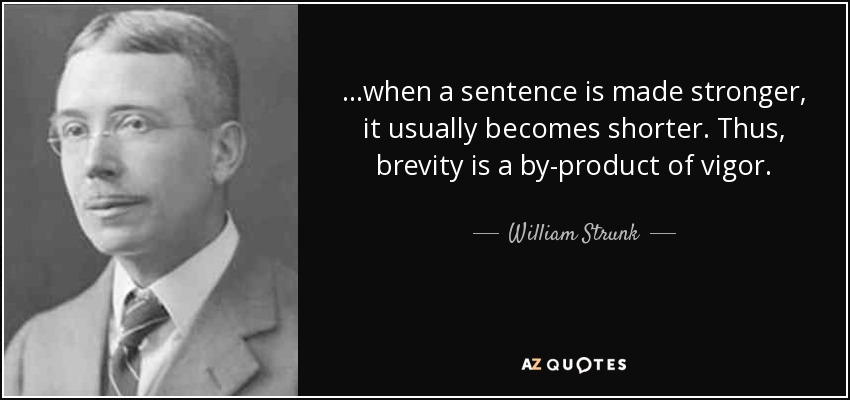


At any rate, “Briefly” is a 639-word essay, which I’ll cut to 345 words (apologies to George Orwell) as an exercise in creating blog content:

EVERYONE knows tweeting is ruining kids’ writing.

Or is it? Structuring sentences into 140 characters might be teaching young writers one of the most cherished virtues among those who deal professionally with writing: brevity. Johnson has just changed jobs, from reporting to editing. Before, copy went from my hands to another's, and it was their job to query, reshape and trim it—difficult work that inevitably made it better. Now I am on the other end of the exchange, and much of my first week was spent merely making pieces shorter.

Editing for print means not only making sure a piece is interesting and accurate, but also meeting a space-limit tightly defined by the size of a page. Online, when an editor asks for 650 words and a writer sends 1,100, the result is a groan.  When this happens in print with a deadline looming, the result is panic. The piece simply must fit.

Why do people write more than they should, when most people find writing difficult? This may be because during their education, young writers are given a kind of assignment that may do lasting harm: they are told to write papers to minimum lengths.


Why do more teachers not, instead, give students an appreciation for brevity? William Strunk, one of the authors of the American usage guide “Elements of Style”, was said by his student (and later editor) E.B. White to grip the lectern in his writing class and say “Omit needless words! Omit needless words! Omit needless words!”

A rule should not, of course, become a compulsion. Strunk did not need to say “Omit needless words!” three times, but it is more memorable that way. Anyone snipping every needless word from our style guide would turn its attempts at gentle humour into relentless hectoring.

As for teachers, try the following trick: assign students a paper of ten pages, and then tell them the real assignment is to trim it back to five in class, with the clock ticking. Then send the student who completes the assignment fastest to our internships page. 

As for UNF, I’ll be extremely annoyed in two weeks if I can’t get into my last class because I’m wait-listed.


Tuesday, August 4, 2015

August dogs

Obviously not a snapshot with a smartphone but a tie-in with Elliott Erwitt at Flipped Again.

Elliott Erwitt: New York City 2000

Elliott Erwitt: Dog Show, Birmingham 1991


I assume blog followers have no objection to bulldogs or poodles.


Saturday, August 1, 2015

Dog day of August


Southside Animal Clinic sent a Happy Birthday e-card to Jorja. We must have told them she was born today. I think she's seven. 


"Yo... what's up with that?" 


Saturday, April 11, 2015

Don't go there...


NOTE (to marine biologists without artistic license) -- 
The crustacean featured here is, obviously, a lobster.

  Cancer. Salvador DalĂ­ 1967


Sunday, August 10, 2014

The case for brevity

The Great War began in Europe 100 years ago this month. America did not enter World War I until April 1917. At its close, E.B. White was a student at Cornell University. He took an English course in 1919 with William Strunk, Jr. A little book penned by the professor named The Elements of Style was the course text.

White graduated from Cornell, proceeded to forget about Strunk's little book until Macmillan commissioned him to revise it in 1957. He added CHAPTER V - AN APPROACH TO STYLE with such useful reminders as "Write with nouns and verbs."

White revised his revision in 1972, then again in 1979, for which he wrote an introduction introducing William Strunk. The professor sarcastically coined the phrase 'little book' as it was privately published by himself. In its original form, The Elements of Style was a 43-page summation of the "case for cleanliness, accuracy and brevity" in composition.


White warns William Strunk's rules and principles are a series of commands. "Omit needless words" is imperative. White strived for 60 years to omit needless words after the professor's oration on brevity:
Vigorous writing is concise. A sentence should contain no unnecessary words, a paragraph no unnecessary sentences, for the same reason that a drawing should have no unnecessary lines and a machine no unnecessary parts. This requires not that the writer make all sentences short or avoid all detail and treat subjects only in outline, but that every word tell.  
***

"There you have a short, valuable essay on the nature and beauty of brevity - 
59 words that could change the world," said E. B. White. 

"Subject-Verb-Object" is my reply.


Saturday, August 2, 2014

Final Credit

There are two obvious similarities between "Long Live Walter Jameson" and "Queen of the Nile"-- old women are catalyst characters and the episodes end with the central characters as dust within suit clothes on the floor. Queen was Charles Beaumont's final Twilight Zone credit but his friend Jerry Sohl actually wrote the teleplay. 

Sohl had owned a scarab ring, a symbol of immortality, which inspired the idea. The two worked out the story details in a half hour and Sohl went home to write the teleplay. It kind of shows. The plot of Queen is not as intricately woven as Walter Jameson. The two main characters are shallow and uncompelling. The old woman, who is the the Queen's mother (daughter?), steals the show.
       
But I think Sohl wrote Queen as almost a tribute to, rather than a rehash of, Walter Jameson. Beaumont suffered from a "mysterious brain ailment" in which he began to age rapidly, his speech slowed, and he lost his ability to concentrate. Eerily, his son said when he died at age 38, Charles Beaumont looked to be about 95 years old. 


Queen of the Nile
Episode 143, original air date: 3-6-1964